October 21, 2026
Falkor demonstrates spatial intelligence for industrial AI agents with NVIDIA Omniverse
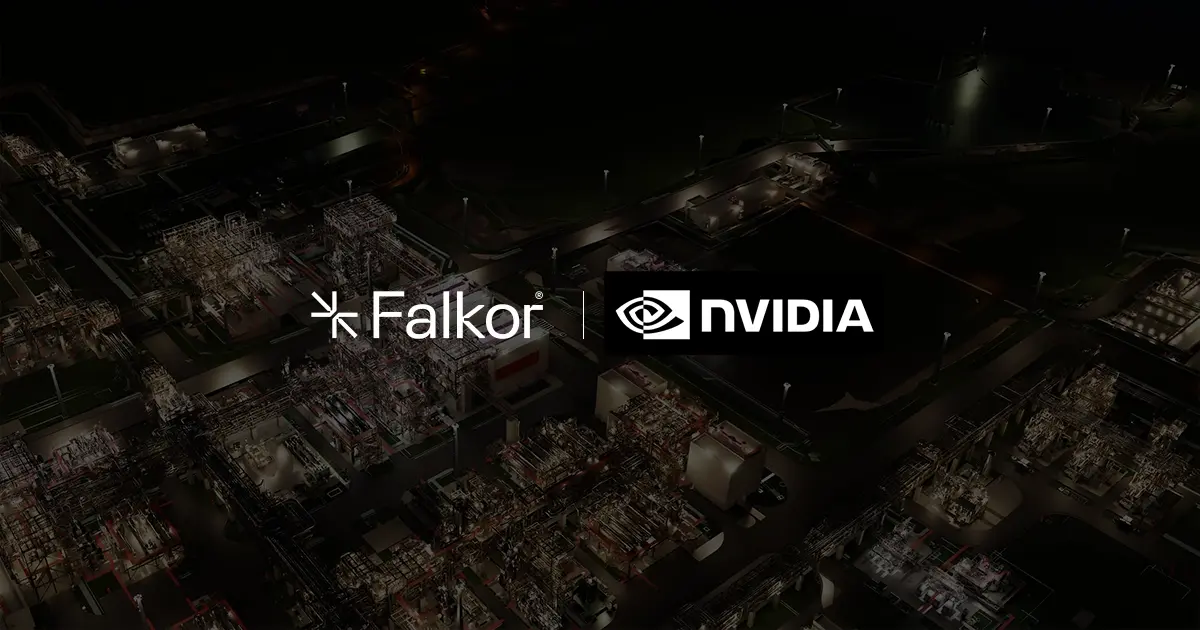
New capabilities allow AI agents to interpret industrial environments, test physical constraints, and support inspection and maintenance planning.
At NVIDIA GTC Berlin, Falkor, a KONGSBERG company, demonstrates AI agents that can see, simulate, and reason over industrial facilities, combining engineering data, operational information, and equipment geometry to support inspection and maintenance decisions.
Built with NVIDIA Omniverse libraries and OpenUSD, the demonstration in Falkor Surface shows how AI agents with spatial intelligence can use industrial context, rendered evidence, and simulation to assess physical assets and work activities. Unlike conventional AI systems that work primarily with documents and data, they can also account for physical relationships such as location, access, and equipment constraints.
Falkor is working with NVIDIA and Microsoft to bring these capabilities into industrial workflows, running on Microsoft Azure AI infrastructure. NVIDIA provides the spatial computing and simulation foundations, while Falkor provides the industrial context that allows AI agents to operate on real assets. The demonstration builds on the collaboration with NVIDIA announced at Hannover Messe in April 2026.
The use cases are being developed with input from international energy operators, with an initial focus on inspection and maintenance planning. By bringing together industrial data and physical context, AI agents could help operators focus inspection efforts where they matter most, identify potential issues before work reaches the field, and make faster, better-informed decisions.
AI agents shorten the distance between a complex question and a decision someone is willing to sign off on. The decision stays with the person accountable for it. What moves is how fast the evidence behind that decision can be assembled, across thousands of components and the systems that describe them.
Shane McArdle, President & Chief Executive Officer, Falkor
Prioritizing inspection and maintenance work
In a reference facility test, an agent combined spatial context, process conditions, temperature data, inspection history, and planned work to narrow 4,847 flanges down to 25 candidates for engineering review. The evidence and reasoning behind each recommendation remained visible to the engineer.
In maintenance planning, agents can allow operators to assess physical constraints such as equipment clearance, crane reach, and access routes. Interactive physics also allows proposed activities to be tested before work begins on site, while the plan is still cheap to change.
Building industrial context for AI
Much of today’s physical AI work assumes a world that is already machine-readable: a clean CAD model, or a synthetic environment built for the purpose. Operating facilities rarely offer that. They are documented across CAD models, drawings, and operational systems with inconsistent structures and identifiers, and even where CAD exists, it may no longer reflect the plant as built. Falkor’s CAD Import Engine derives highly optimized, SimReady OpenUSD directly and automatically from a facility’s engineering CAD, with relevant NVIDIA libraries embedded in the pipeline. Agents draw on the Digital Twin’s engineering data to enrich the scene, and asset identity in the resulting scene resolves back to the twin graph. When the CAD changes, the scene is regenerated rather than remodeled.
Falkor composes NVIDIA Omniverse libraries (ovstage, ovrtx, ovphysx, and ovstream) for OpenUSD scene access, RTX rendering, physics simulation, and streaming across the Falkor Platform, and brings them to users through Falkor Surface. Rendering and simulation run on Azure, on NVIDIA RTX PRO 6000 Blackwell Server Edition GPUs.
Where no up-to-date CAD model exists, agents powered by OpenAI’s GPT-6 Astra build an OpenUSD model of the plant from engineering drawings and anchor it to as-built captures such as laser scans, with every part traceable to its source. Because Falkor sources GPT-6 Astra and its other OpenAI models through Microsoft Foundry, operators can apply frontier models to their asset data on a platform they have trusted for many years.
“AI agents that can understand the real world and use foundational knowledge and tools are transforming industries,” said Vikram Natarajan, General Manager of Omniverse at NVIDIA.
With the integration of NVIDIA Omniverse libraries into the Falkor Platform, Falkor AI agents help engineers simulate and test new plans and constraints, turn data into intelligence, and accelerate the path to autonomous operations across the heavy industries.
Vikram Natarajan, General Manager of Omniverse, NVIDIA
Evidence, provenance, and human control
Consequence is asymmetric in this industry: being wrong about a flange or a lift is not a rounding error. The capabilities operate within defined identities, permissions, and workflows. Users can review the sources, calculations, model outputs, and AI-generated inferences behind a recommendation before deciding whether it should progress toward action.
Read more about the technology behind itAbout Falkor
Built on more than 200 years of the KONGSBERG Group’s industrial heritage and continuing on that foundation, Falkor is trusted by leading operators, engineers, and asset managers across the energy, processing, power, and renewables sectors. Falkor enables organizations in heavy-asset industries to expand human capability and redefine how assets are designed, operated, and optimized across their lifecycle. By connecting people, systems, and workflows, its industrial intelligence platform turns complexity into clarity and data into decisions – so that leading companies can improve safety, efficiency, and performance.
Media enquiries

Falkor Communications
Related news
June 1, 2026
Kongsberg Digital rebrands as Falkor, a KONGSBERG company

April 24, 2026
Wipro partners with Kongsberg Digital to transform the energy & utility sector with advanced AI‑powered digital twins
April 22, 2026
Kongsberg Digital and Yara recognized with Microsoft Intelligent Manufacturing Award at Hannover Messe
April 20, 2026
Kongsberg Digital advances AI-driven spatial environments for industrial operations with NVIDIA Omniverse