October 21, 2026
From geometry to reasoning
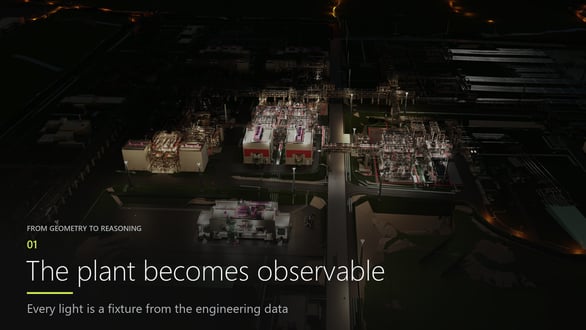
Video: A dynamic simulation of the physics of light, where every light comes from a fixture in the facility’s engineering data. Falkor turns that data into meaning, and the simulated result gives AI agents evidence to reason over.
How Falkor turns engineering data into a world AI agents can see, simulate, and reason over, with NVIDIA Omniverse.
At NVIDIA GTC Berlin, Falkor, a KONGSBERG company, demonstrates how AI agents can see and work within industrial facilities, with NVIDIA Omniverse libraries composed into the Falkor Platform and brought to people through Falkor Surface. This post shows what that means for the people who plan, inspect, and investigate the work.
What makes this footage interesting goes much deeper than what you immediately see: a dynamic simulation of an industrial facility, using a SimReady OpenUSD representation derived directly and automatically from the facility's engineering CAD. Individual geometric objects are linked to their corresponding asset tags, while agent-driven semantic mining enriches the scene with information from the facility's engineering data. Every light visible in the scene originates from a fixture documented in that data, and its light is physically simulated. When the underlying CAD changes, the scene can be regenerated by rerunning the pipeline. Geometry becomes semantics. Semantics drive behavior. Agents can reason over the resulting simulated evidence.
What the asset already knows
Every asset runs inside an operating envelope, and every intervention has to fit a window: a weather window offshore, a maintenance window, a permit window. Alarms and technical monitoring guard the edges of the envelope. The harder work happens inside it: noticing a change that is not an alarm, tracing it through the process, and working out what caused it. That is where the exceptions worth acting on are found.
The stakes are measured in deferment: production lost or delayed. Much of the work behind it is manual and repeated, and time spent monitoring and interpreting signals is time not spent on production optimization, where a fraction of a percent adds up to significant value over an asset's life. Inspection and maintenance absorb thousands of hours on a large facility, much of it because it is hard for people to scope exactly what should be inspected, where, and when.
Behind all of this sits the energy trilemma: supply that must stay secure, energy that must stay affordable, and emissions that must come down, all from the same assets. It is not solved once. It is balanced, every day.
The data needed to strike that balance mostly exists: the CAD model, the tag register, the maintenance history, the process historian, the inspection records. But industrial data is permanently incomplete. It sits in systems that were never designed to be read together, and the as-built diverges from the as-designed on day one and keeps diverging. An experienced engineer does not stop working because the documentation is wrong. They reason around it. Software now has to do the same, against the physical plant: where things are, what surrounds them, what they connect to, and what happens when something changes. Data quality becomes an output of that loop rather than a precondition for entering it.
AI agents shorten the distance between a complex question and a decision someone is willing to sign off on. The decision stays with the person accountable for it, whether that is a work permit, an inspection plan, or a lift plan. What moves is how fast the evidence behind it can be assembled.
Two things make the rest possible
Falkor's Digital Twin has connected industrial identity, engineering information, operational data, documents, geometry, and trusted models for years, and its AI agents already work across that context. Agents can interpret a person's objective, call specialized tools, invoke simulations, and collaborate with other agents. The Digital Twin has long made geometry useful to people. The emerging question is how geometry becomes useful to intelligent machines.
The first is that the asset became legible. A CAD model may contain millions of shapes and loosely structured attributes. An experienced engineer sees pumps, separators, valves, pipe systems, access routes, and functional relationships. Agents orient themselves in raw engineering data, learning a facility's own vocabulary from its structure and attributes, without imposing a standard, so the plant can answer questions about what it contains. Falkor calls this semantic mining. It represents years of work, and everything below depends on it.
The second is that the plant became observable. A physically based render obeys the physics of seeing: what is visible from where, what blocks what, how far light reaches, and how big things are relative to each other. The image is a consequence of what the engineering data says, which makes it something an agent can reason over. One example: light a facility using only the fixtures its own data documents, and you can ask whether a work area is lit well enough to run a job at night. Where an area stays dark, that points to a possible lighting gap or missing fixture data, and either is worth investigating. Rendering gives the agent eyes. The same render serves two readers. A person walks the asset at any hour from anywhere. An agent requests a view, identifies the equipment behind a given pixel, changes the scene, and looks again.
VIDEO: A dynamic simulation of an industrial facility, rendered with NVIDIA's ovrtx library from an OpenUSD model that the Falkor CAD Import Engine created from the engineering CAD. Agents found every light fixture through semantic mining; each fixture's bulb type sets its color, and its wattage its intensity. Light is the most visible example of engineering data driving behavior in the scene.
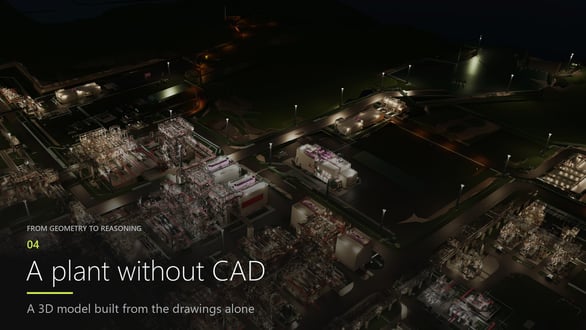
Much of today's physical AI work assumes a world that is already machine-readable: a clean CAD model, or a synthetic environment built for the purpose. Operating facilities rarely offer that. They are documented across CAD models, drawings, and operational systems with inconsistent structures and identifiers, and even where CAD exists, it may no longer reflect the plant as built. Turning such a facility into a world that software can perceive, simulate, and act within is the precondition for everything that follows, and it is the work Falkor has industrialized. There are two routes into that world. Where usable engineering CAD exists, it is converted, enriched, and regenerated as it changes. Where it is missing or out of date, agents reconstruct a model from drawings and anchor it to as-built captures.
The work, journey by journey
Legible and observable are where it starts. Semantics drive behavior, behavior enables interaction, interaction enables simulation, and simulation enables reasoning. Reasoning is the destination, and it is where the work gets done.
Follow the flow
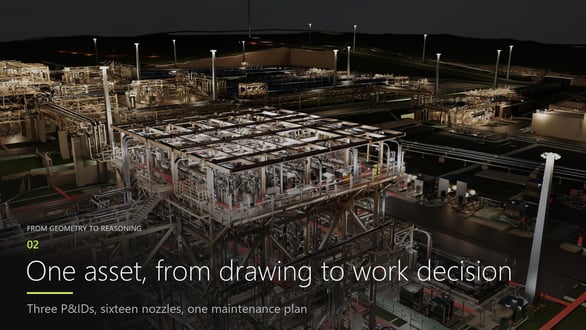
An agent reads a P&ID and highlights every part that belongs to it, follows a line from one sheet to the next, and puts the process back into the plant, so you see where the job actually is. Where drawings are missing or out of date, an agent infers what connects to what, and which way it runs, from the geometry itself. Where the evidence is thin, it says so: what the available data supports, and how much confidence the result deserves.
Stand at the worksite with the team before anyone commits to the plan
A maintenance planner's questions are physical. Is there clearance to withdraw the valve? Can the crane reach? Which access route still works once the scaffolding is up? Can two crews work the same area at the same time? An agent that can see the plant answers these while the plan is still cheap to change, which is when the answer is worth the most. With interactive physics in the same world, an agent can test whether a lift clears the structure before anyone commits to it. On one maintenance job, an agent checked that there was room for a person to stand and work, found that a short handling zone for the part was clear while a longer one hit the railing, and gave the planner a two-stage option with the open questions listed.
VIDEO: An agent on the Falkor Platform follows one vessel across three P&IDs, puts its process back into the plant, and verifies all 16 of its nozzle connections. It then checks a maintenance job at a strainer: a short handling zone is clear, a longer one meets the railing, and the planner gets a two-stage option in Falkor Surface with the open questions named.
Simulate scenarios
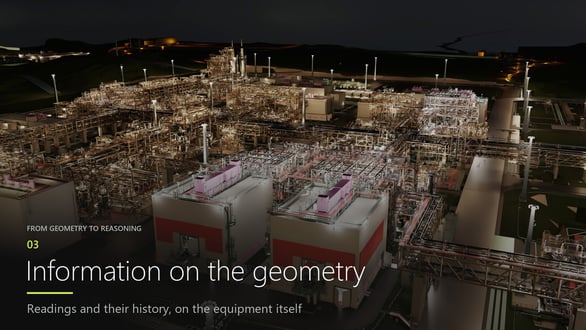
Where a question is genuinely about future behavior, the agent selects and invokes a validated model to compute the answer. The simulator computes; the agent reasons about which model to ask, and about what the result means for the equipment in front of the person. Engineering-grade simulators such as K-Spice and LedaFlow provide validated models of process and flow behavior. Emulators provide faster approximations for bounded questions and broader scenario exploration. NVIDIA physics simulation libraries add spatial interaction, collision, articulation, sensors, and physical behavior within the OpenUSD world.
VIDEO: In Falkor Surface, simulation results and recorded readings are visualized on the equipment, to keep their spatial context: a simulated level and temperature field, measured inlet and outlet temperatures, and at plant scale, simulated temperature across three coolers.
From every flange on the plant to the short list worth the hours
An inspection engineer starts with more candidates than time, and with the context for the decision spread across systems that were never joined up. An agent applies spatial exposure, process conditions, temperatures, inspection history, and planned work in turn. On one reference facility, that screening narrowed all 4,847 flanges on the plant to 25 candidates for engineering review, with the reasoning behind each one open to challenge. The numbers will differ from one facility to the next. The pattern is what carries over.
Evidence, provenance, and human control
Consequence is asymmetric in this industry. Being wrong about a flange or a lift is not a rounding error, which is why evidence, provenance, and human control are product features here rather than compliance decoration. Industrial agents operate within defined identities, permissions, and workflows. Results distinguish retrieved facts, model outputs, rendered or spatial observations, calculations, and AI inference. Where a drawing shows something but does not locate it, the agent does not invent a position; it leaves the item out of the model. Where two drawings disagree, it keeps the disagreement visible. Every part of a generated model can point back to the drawing it came from. The person sets the objective, sees which sources and models contributed to a conclusion, challenges it, and decides how far it should progress toward action.
VIDEO: With no up-to-date CAD model, an agent builds an OpenUSD model of the plant from the drawings alone: symbols, data tables, access, section and detail drawings, six P&IDs joined into one process, and placement from the plot plan. None of it is modeled by hand, and what the drawings do not say stays marked as unknown or assumed.
A few months of momentum
At Hannover Messe in April, Falkor announced its work with NVIDIA Omniverse libraries.
Since then, the way the two fit together has changed. The earlier integration model centered on adopting or extending a substantial Kit-based application stack. The new model decomposes key Omniverse capabilities into focused libraries, APIs, microservices, and associated skills, and Falkor has moved its spatial capabilities onto it.
Agents run the pipeline end to end. The scene in the footage above is a dynamic simulation, rendered on Microsoft Azure nodes running NVIDIA RTX PRO 6000 Blackwell Server Edition GPUs.
How it fits together?
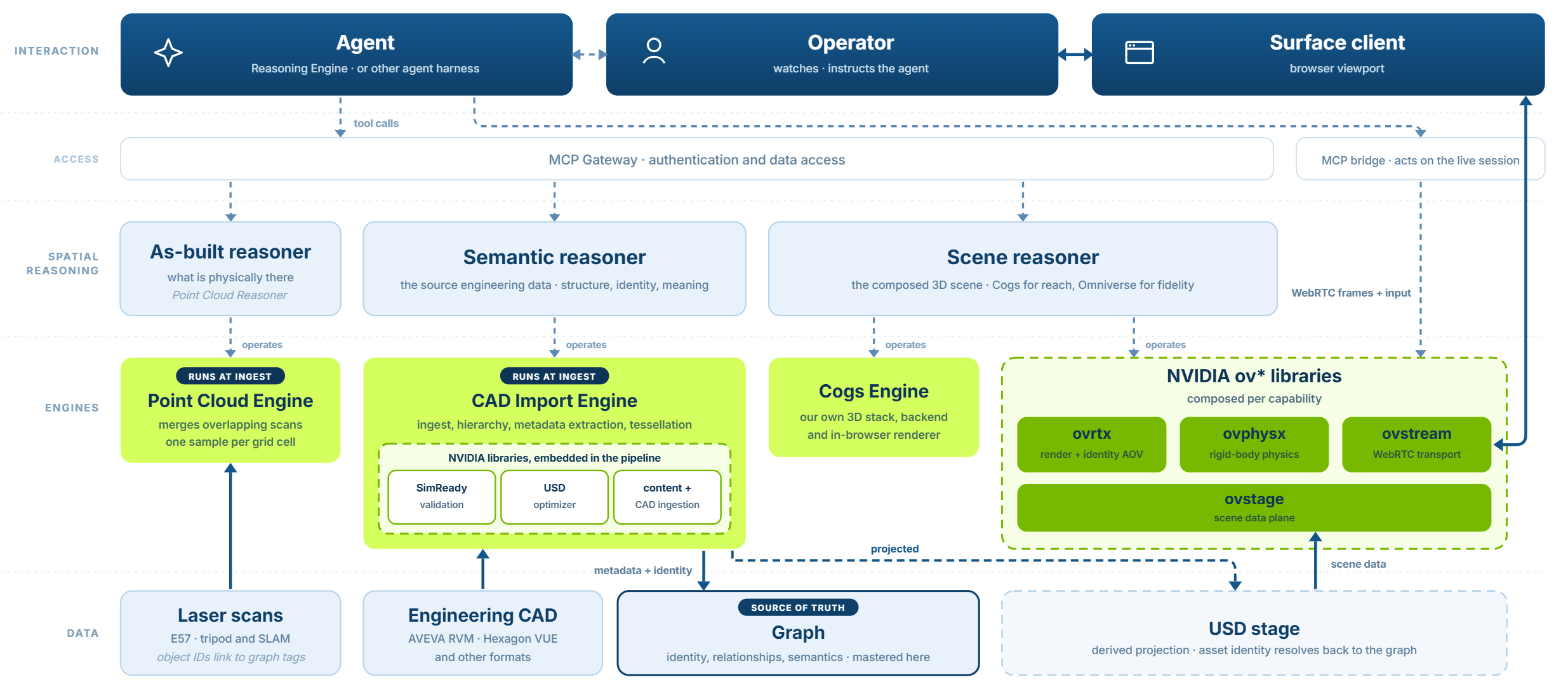
IMAGE: The Falkor architecture, from the people and agents doing the work at the top to the engineering data underneath. Reasoners give agents a cockpit around specialized engines, including NVIDIA Omniverse libraries, and the graph remains the source of truth.
The architecture reads from top to bottom, from the people and agents doing the work to the engineering data underneath it.
At the top, a person and an agent share the same session. The agent can be Falkor's Reasoning Engine or another agent harness. The operator watches and instructs it, and the Surface client carries the shared view to the browser. Agents reach the platform through an MCP gateway that handles authentication and data access, and act on the live session through an MCP bridge.
Beneath them sit reasoners. A reasoner is an agent-accessible interface around a specialized engine that combines controls with the observations and context needed to operate it iteratively. The agent performs the reasoning; the reasoner provides its cockpit around the engine. A semantic reasoner works over the source engineering data: structure, identity, and meaning. A scene reasoner works over the composed 3D scene, using Falkor's own Cogs engine for reach and NVIDIA Omniverse for fidelity. An as-built reasoner works over captures of the facility as it stands, starting with laser scans.
The engines are where NVIDIA's libraries do their work, each composed for a specific capability:
- ovstage gives agents a scene data plane to load, query, and change the OpenUSD world, isolating equipment or staging a scenario rather than only looking at it.
- ovrtx renders the scene with equipment identity attached, so an agent knows what it is looking at, pixel by pixel.
- ovphysx adds interactive physics, such as detecting whether a crane collides with the structure during a lift.
- ovstream streams the rendered view into Falkor Surface, in any browser.
- SimReady validation, USD optimization, and CAD ingestion run inside the Falkor CAD Import Engine, as the world is built from engineering CAD.
At the bottom sits the data. Engineering CAD remains authoritative for the engineering design. As-built captures supply measured evidence of the plant as it stands. Falkor's graph is the source of truth for identity, relationships, and engineering semantics. The OpenUSD stage is a derived spatial projection, and asset identity resolves back to the graph.
NVIDIA libraries provide a reusable spatial and physical foundation. Falkor supplies the industrial meaning that makes them useful on a real asset. Libraries are callable capabilities. Skills carry procedural knowledge. Agents perform the composition. The unit of integration moves from the application to the capability.
AI on every side of the table
AI participates on every side of this environment. Engineering agents help teams integrate rapidly evolving technologies and turn industrial capabilities into reusable tools. Falkor's work with NVIDIA Omniverse libraries demonstrates this mode: engineering agents use NVIDIA skills to implement capabilities against early library releases. Upstream agents help prepare the industrial world by inspecting source CAD, resolving identities, proposing classifications, enriching geometry, and validating derived representations. The path from engineering CAD to a simulation-ready spatial world becomes an ongoing reasoning process rather than a one-time file conversion. Within operational workflows, specialist agents retrieve information, calculate, render, measure, simulate, compare, and prepare actions.
Agents are now reliable in code and command-line workflows. Reasoning about 3D space is the next frontier. The step beyond agentic software engineering is agentic spatial engineering.
Frontier models that reason over 3D space, such as OpenAI's GPT-6 Astra, extend what these agents can do: building with Omniverse libraries, composing and validating OpenUSD scenes, and interpreting what an agent sees in a rendered view.
Agentic spatial engineering, in practice
The work follows one line: generate a plant model from evidence, ground it against reality, then simulate and operate on it.
Agents powered by GPT-6 Astra do the spatial reasoning. Underneath them is Falkor's product: the knowledge graph, and reasoners that let agents work directly with the CAD Import Engine.
Where a facility has no up-to-date CAD model, the agent starts from the drawings. It writes the 3D geometry itself, sized from what it reads in P&IDs, isometrics, and arrangement drawings, and joins the sheets into one connected process in OpenUSD. It then anchors that model to as-built captures of the facility, starting with laser scans. Drawings supply the documented equipment and relationships. Captures supply measured spatial evidence. Where documents and capture disagree, the discrepancy is surfaced for engineering review.
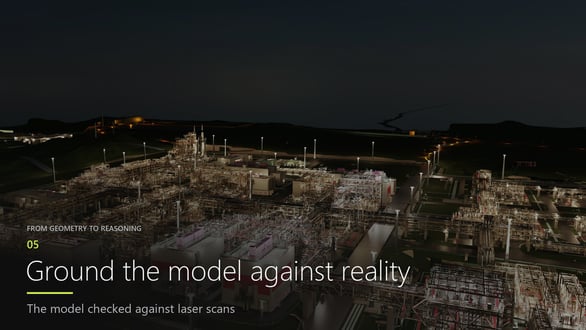
VIDEO: A model built from drawings shows a plant as designed; a laser scan shows what is physically there. Through the Point Cloud Reasoner, an agent on the Falkor Platform builds the structure and the process from the drawings, places each vessel where the measured points support it, and checks what it built against the scan. Rejected fits and proposed routes stay visible for review.
At NVIDIA GTC Berlin
Falkor is working with NVIDIA and Microsoft to bring AI and spatial intelligence into a product built for heavy-asset industries, running on Azure AI infrastructure. Because Falkor sources GPT-6 Astra and its other OpenAI models through Microsoft Foundry, operators can apply frontier models to their asset data on a platform they have trusted for many years. The use cases are being developed with input from international energy operators, with an initial focus on inspection and maintenance planning.
In Berlin, Falkor shows an agent connecting geometry to equipment identity and operational context, and using rendered evidence within a governed industrial workflow. The capabilities shown in Berlin are part of the continuous evolution of Falkor Surface and the Falkor Platform, available on Microsoft Marketplace.
To explore what this could mean for your assets, connect with a Falkor expert at falkor.com.
Frequently asked questions
At NVIDIA GTC Berlin (October 21-22, 2026), Falkor, a KONGSBERG company, demonstrated AI agents with spatial intelligence that can see, simulate, and reason over industrial facilities, with an initial focus on inspection and maintenance planning. In Falkor Surface, an agent connects 3D equipment geometry to equipment identity and operational context, and uses rendered evidence within a governed industrial workflow. The demonstration composes NVIDIA Omniverse libraries into the Falkor Platform and runs on Microsoft Azure AI infrastructure. Read the press release.
Spatial intelligence is an AI agent's ability to reason about a physical facility: where equipment is, what surrounds it, what it connects to, and what happens when something changes. Conventional AI systems work primarily with documents and data. Falkor's AI agents with spatial intelligence can also account for location, access, clearance, and equipment constraints, which inspection and maintenance decisions depend on.
No. Industrial data is permanently incomplete: it sits in systems that were never designed to be read together, and the as-built plant diverges from the as-designed one from day one. Falkor's approach treats data quality as an output of the work rather than a precondition for starting it, with software reasoning around gaps against the physical plant the way an experienced engineer does. Where the evidence is thin, the agent says what the available data supports and how much confidence the result deserves.
Falkor's AI agents support four industrial journeys, with an initial focus on inspection and maintenance planning developed with input from international energy operators:
- Follow the flow: reading P&IDs (piping and instrumentation diagrams), following lines from one sheet to the next, and placing the process in the 3D plant.
- Work planning: checking clearance, crane reach, access routes, and simultaneous crew work, and testing with interactive physics whether a lift clears the structure, before a maintenance plan is committed.
- Scenario simulation: selecting and invoking validated process and flow simulators such as K-Spice and LedaFlow, rather than estimating the answer.
- Inspection prioritization: on a reference facility, an agent narrowed all 4,847 flanges on the plant to 25 candidates for engineering review, applying spatial exposure, process conditions, temperatures, inspection history, and planned work in turn.
There are two routes. Where usable engineering CAD exists, the Falkor CAD Import Engine converts it directly and automatically into a SimReady OpenUSD (Universal Scene Description) model, links each geometric object to its asset tag, and agents enrich the scene from the facility's engineering data, which Falkor calls semantic mining. When the CAD changes, the scene is regenerated rather than remodeled by hand. Where CAD is missing or out of date, AI agents powered by models such as OpenAI's GPT-6 Astra build the 3D model from P&IDs, isometrics, and arrangement drawings, and anchor it to as-built captures such as laser scans, surfacing any disagreement for engineering review.
Falkor uses OpenAI's GPT-6 Astra, a frontier model that reasons over 3D space, to power the agents that do spatial reasoning in the Falkor Platform. Astra-powered agents build with NVIDIA Omniverse libraries, compose and validate OpenUSD scenes, interpret what they see in a rendered view, and reconstruct plant models from engineering drawings. Underneath them is Falkor's product: the knowledge graph, and reasoners that let agents work directly with the Falkor CAD Import Engine.
Falkor sources GPT-6 Astra and its other OpenAI models through Microsoft Foundry, so operators can apply frontier models to their asset data on a platform they have trusted for many years.
Ovstage, ovrtx, ovphysx, and ovstream are NVIDIA Omniverse libraries that Falkor composes into the Falkor Platform, each for a specific capability:
- ovstage gives AI agents a scene data plane to load, query, and change the OpenUSD world.
- ovrtx renders the scene with equipment identity attached, so an agent knows what it is looking at, pixel by pixel.
- ovphysx adds interactive physics, such as detecting whether a crane collides with the structure during a lift.
- ovstream streams the rendered view into Falkor Surface, in any browser.
SimReady validation, USD optimization, and CAD ingestion run inside the Falkor CAD Import Engine.
No. The decision stays with the person accountable for it, whether that is a work permit, an inspection plan, or a lift plan, and AI agents shorten the time it takes to assemble the evidence behind it. Falkor's industrial agents operate within defined identities, permissions, and workflows, and their results distinguish retrieved facts, model outputs, calculations, and AI inference. Where a drawing shows something but does not locate it, the agent leaves it out of the model rather than invent a position, and every part of a generated model can point back to the drawing it came from. The person sets the objective, challenges the conclusion, and decides how far it should progress toward action.
NVIDIA libraries provide a reusable spatial and physical foundation, Falkor supplies the industrial meaning that makes them useful on a real asset, and the product runs on Microsoft Azure AI infrastructure and is available on Microsoft Marketplace. Falkor announced its work with NVIDIA Omniverse libraries at Hannover Messe in April 2026. Since then the integration model has changed from adopting or extending a Kit-based application stack to composing focused Omniverse libraries, APIs, microservices, and skills, and Falkor has moved its spatial capabilities onto the new model. The scene shown at GTC Berlin is a dynamic simulation, rendered on Microsoft Azure nodes running NVIDIA RTX PRO 6000 Blackwell Server Edition GPUs, and Falkor sources GPT-6 Astra and its other OpenAI models through Microsoft Foundry.
Author

Falkor
Falkor is a KONGSBERG company that enables organizations in heavy-asset industries to expand human capability and redefine how assets are designed, operated, and optimized across their lifecycle. By connecting people, systems, and workflows, Falkor’s industrial intelligence platform turns complexity into clarity and data into decisions – so that leading companies can improve safety, efficiency, and performance.
Related news
October 20, 2026
What energy leaders are really talking about ahead of ADIPEC 2026
August 31, 2026
ONS 2026: Building the foundations for industrial intelligence
May 4, 2026
The energy industry is buying AI, but not scaling it. Here is why.

April 15, 2026
Industrial intelligence is becoming a priority for manufacturing