Use cases
June 12, 2026
Real-time data quality is now a safety issue
Industry: Oil & gas
Asset type: Wells
Solution: Operations & performance

Background
In well operations, quality of data has traditionally been treated as a data management problem. Something to be addressed after the fact, by specialists, during post-operation reviews or in preparation for reservoir modelling. The thinking goes: the real-time data may be noisy, but the important decisions are made by experienced people who know how to filter out the noise.
Today, real‑time data feeds wellbore stability prediction calculations, rig or well digital twins and other systems that directly influence operational decisions, often without a human filtering step. When corrupted or degraded data enters those workflows unnoticed, teams don’t just lose time. They risk making decisions based on inputs that look reasonable but are wrong.
The hidden cost of bad data
Poor real-time data quality rarely shows up as a single, clearly identified cost.
At the low end of severity, bad data means wasted time. As an example, a remote operations geology specialist is watching a pore pressure model that has stopped updating because one of its input channels has dropped out, and spends twenty minutes diagnosing the cause before they can continue their analysis.
Each of these is an “Non-Productive Time” event, measured in lost work hours of highly skilled engineers. Across a multi-well program, they add up to a significant and entirely avoidable drain on technical resources.
At the higher end of severity, bad data becomes a decision quality problem. A pore pressure model that has been silently receiving corrupted inputs produces an output that looks reasonable but is wrong. The drilling team, trusting the model because they have no visibility into the quality of its inputs, makes a mud weight decision based on that output. The consequences depend on the well - but in the industry where margins are moved with ever increasing efficiency, a mud weight decision based on bad data can have serious implications for well integrity.
The three-part problem
SiteCom's approach to data quality is built around a pragmatic understanding of what data quality failure actually involves. It is not a single problem. It is three sequential problems, each of which needs its own solution.
Detection
Something has gone wrong, a sensor failure, dropped packets, a mnemonic changed after a software update, a clock sync issue corrupting depth index. The data has degraded, but nobody knows yet.
Diagnosis
Where is the problem coming from? Is it at the source, the sensor, tool, or acquisition system; or downstream in the transmission layer, data server, or receiving platform? Without that distinction, the response is to check everything, which is slow and expensive.
Notification
The right people need to know in time to act. Service companies, drilling teams, remote operations, data engineers, and third-party analytics providers all depend on different parts of the data chain. Blanket alerts create noise; no alert lets the problem fester.
Green data - clean, validated, continuously monitored - is the foundation on which everything else is built.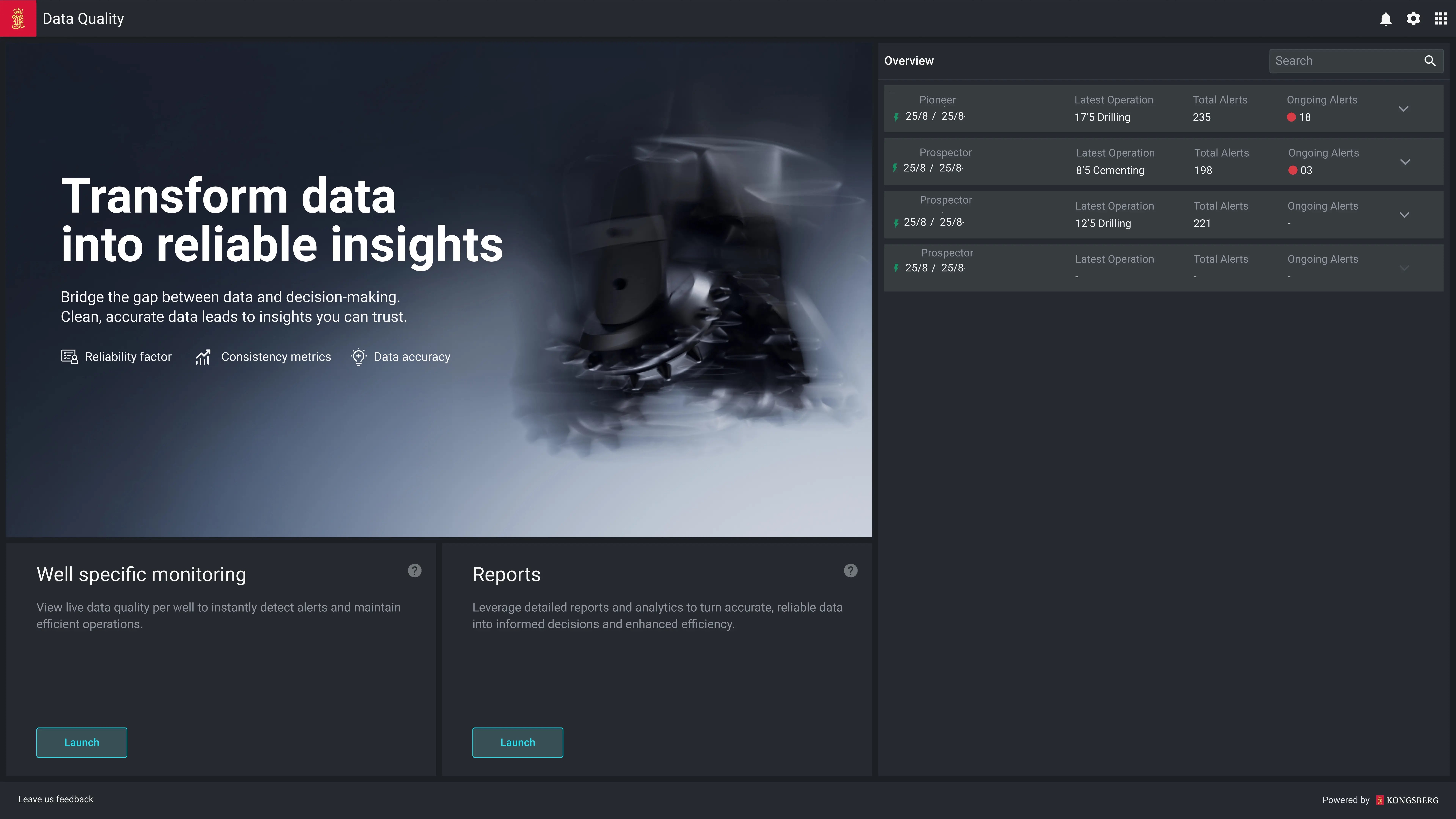
SiteCom Data Quality app with overview of data delivery across real-time operations.
What SiteCom does
SiteCom makes sure it stays green. The Data Quality application (DQ App) addresses all three problems in sequence.
For detection, it provides continuous, automated monitoring of incoming data streams against a set of quality rules – for example flatline detection, gap identification, index consistency validation, and missing channel checks.
When a channel breaches a quality threshold, the system flags it immediately. The monitoring dashboard surfaces any channel issues in real time, so you can confirm whether your data is healthy, without having to investigate individual channels.
For diagnosis, the DQ App tracks quality issues back to their origin in the data chain. By monitoring data quality at multiple points in the transmission path - at acquisition, at the rig gateway, at the cloud ingestion layer - it can identify whether a quality degradation appeared at the source or was introduced in between. This dramatically reduces the time required to isolate and resolve the problem.
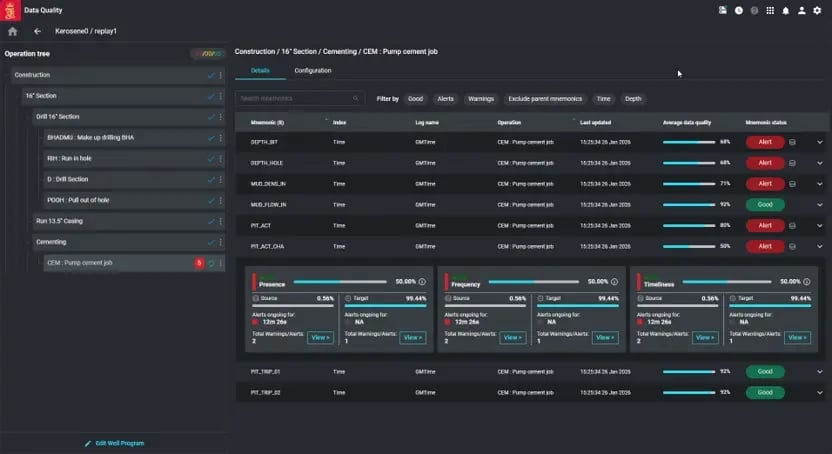
SiteCom Data Quality app detailed breakdown of data delivery in well operation’s context.
For notification, the service alert integration allows operators to define targeted notification rules: who gets alerted, for which quality check failures, on which channels, on which wells. A geomechanics specialist who depends on the sonic log for their stability model can receive an immediate alert if that channel degrades - without being copied on every data quality event across the entire operation. The right people are notified. The wrong people are not distracted.
How data quality is defined and enforced: the Data Work Order
A critical part of making data quality operational is agreeing up front what “green” data actually means for a specific operation. In SiteCom, this is done through a Data Work Order (DWO).
The Data Work Order is a machine‑readable agreement that defines what data should exist for a given operation. It captures required measurements, critical sensors, update frequencies, quality thresholds, and ownership responsibilities — aligned with the operator’s standards and, where relevant, the service data providers. Instead of relying on spreadsheets, emails, and phone calls to align expectations, these requirements are formalised once and applied consistently.
Operationally, the DWO enables collaboration and traceability. Internal stakeholders such as drilling engineers and operations geologists define the measurements they need. Service companies then propose suitable channel combinations based on availability and applicability. As requirements evolve, the Data Work Order is iterated and agreed before execution, and shared with downstream stakeholders such as data management.
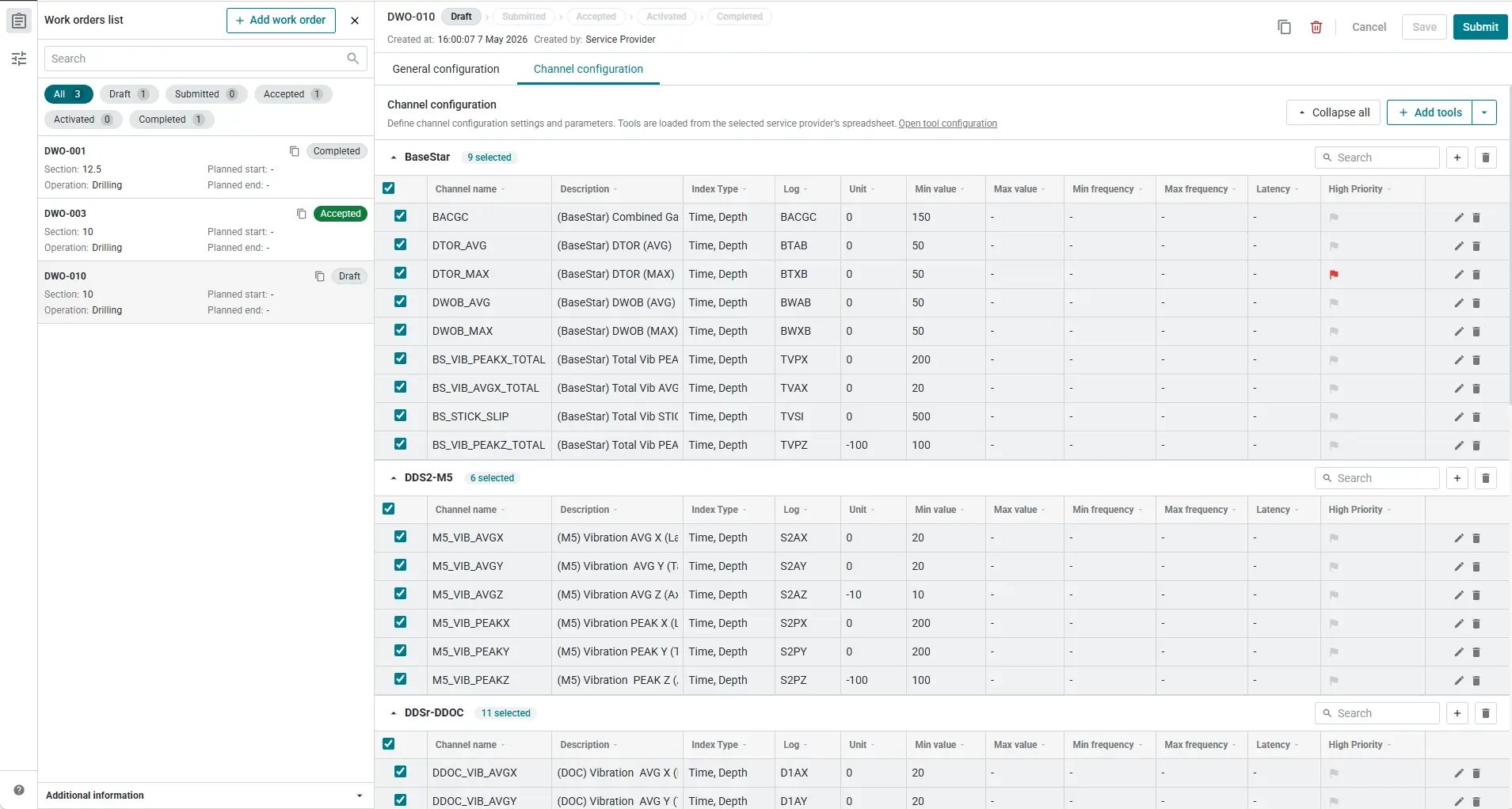
Data Work Order in SiteCom is a space for aligning data delivery between partners
Once in place, SiteCom turns these agreed requirements into data quality rules that are automatically applied across wells and operations. Real‑time monitoring, validation workflows, dashboards, and alerts are all driven by the same agreed data contract — helping systems be pre‑configured for the expected dataset and ensuring that data delivery requirements are continuously monitored during and after operations.
Related use cases
September 23, 2026
Correlation in SiteCom Live: placing formation markers with confidence, in real time
June 26, 2026
SiteCom: Avoiding the hidden costs of inconsistent data with the GM Hub
June 19, 2026
SiteCom: Real-time gas shift analysis for understanding pressure behaviour in HPHT wells
June 3, 2026
SiteCom Link: Closing the gap between disconnected systems and real-time well operations