Use cases
June 19, 2026
Real-time gas shift analysis for understanding pressure behaviour in HPHT wells
Industry: Oil & gas
Asset type: HPHT wells
Solution: Operations & performance
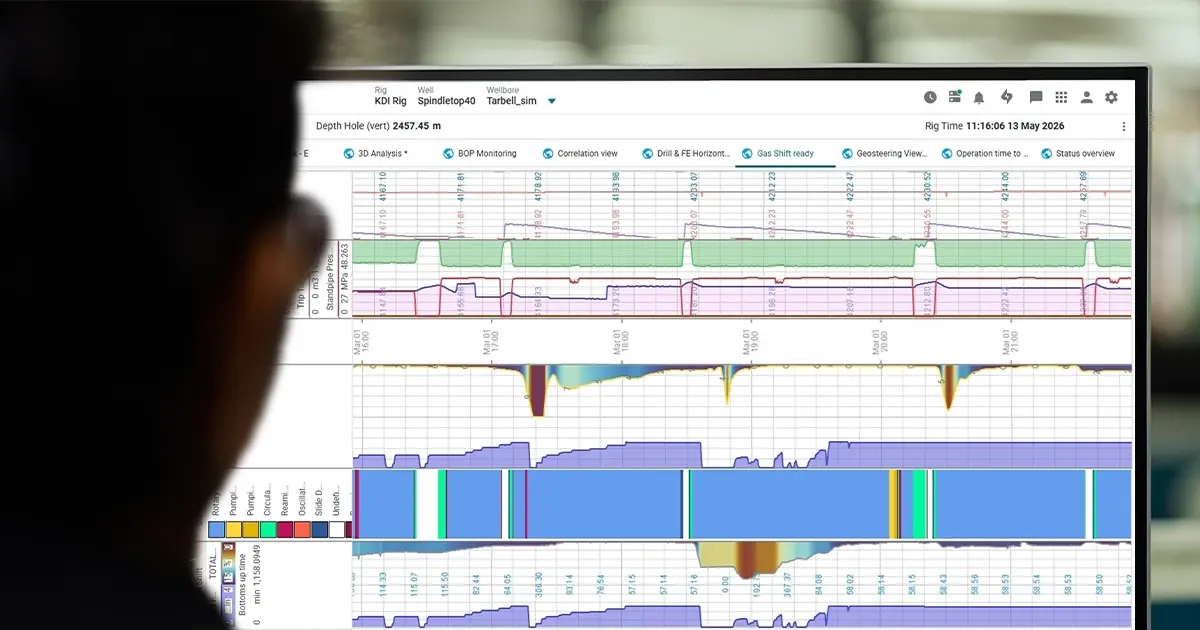
Image: SiteCom's real-time gas shift analysis
Background
In High Pressure High Temperature wells, pressure ramps can occur in certain formations, where predicting pore pressure becomes highly uncertain.
Key challenges observed in well operations include limited formation permeability, which makes log-based pressure prediction unreliable. During drilling, pressure ramps can develop quickly below known stratigraphic markers. Connection gas can become one of the few reliable indicators of pressure balance, even though interpreting gas behaviour is difficult. Additional methods - such as pump-off tests and dynamic pressure tests (e.g., during Managed Pressure Drilling) may provide data, but the results can be difficult to interpret and are not always conclusive.
During real-time operations, a critical question arises: Are gas peaks indicating underbalance, or are they just wellbore effects such as breathing?
Without clear interpretation, decision-making becomes uncertain and slower.
The signal exists. The interpretation is the challenge
Today, the mud logging unit continuously captures gas data. But between the moment gas enters the wellbore and the moment it registers on a surface sensor, a great deal happens and most of it introduces noise.
First and foremost, gas measurements at the surface are delayed compared to downhole events. The delay constantly changes due to well geometry, flow conditions, and drilling progress. Without correction, the signal reflects past conditions not what is happening now. Manual interpretation is possible, but it is slow and depends on individual expertise.
This delay in interpretation can impact safety, non-productive time, and well control risk.
What real-time gas shift actually does
SiteCom's RT Gas Shift analysis addresses this challenge at its root, not by replacing the Mudlogger’s or Operations Geologist’s judgement, but by providing a tool that performs the hard mathematical work automatically and continuously. It enables real-time interpretation.
The core of the capability is the calculation of lag volume using real-time drilling parameters. The lag volume is then used to shift the surface gas signal backward in time, aligning captured readings with the pump-off event that produced them.
This is where connection gas analysis becomes actionable. You can see, clearly and consistently, whether gas levels are elevated during connections, whether that elevation is trending upward as the well progresses, and whether the pattern suggests you are approaching balance or underbalance. These patterns, visible in a corrected and correlated dataset, allow the drilling team and geologist to engage with the pressure prediction model in real time, adjusting mud weight programmes or connection procedures before a situation escalates.
All of this is presented in a dashboard designed for operational use by the drilling team, the geologist, and the real-time remote operations centre monitoring team. In SiteCom, observations can be annotated and shared interactively, creating a living record of the well’s pressure behaviour that supports both immediate decisions and post-well analysis.
Working at scale
This process is designed to run continuously and consistently across wells, allowing the same methodology to be applied at scale. Instead of analysing individual events in isolation, teams gain a comparable view of gas behaviour across different sections, wells, and campaigns. This reduces dependence on individual expertise and creates a consistent way of interpreting pressure signals. Readily available information changes the posture of the drilling team from reactive to proactive.
Gas data must be prepared before it can be trusted. This is achieved through continuous preprocessing and quality checks of incoming data streams, ensuring that measurements are consistent, aligned, and usable.
The approach relies on standard operational inputs, including gas sensor data, flow rate measurements, captured pump-off events such as connections and tests, and lag information or annulus volume.
Save half of a working day for every operation
Operational efficiency is perhaps the easiest dimension to put a number on. When gas shift interpretation is done manually and properly, it eats up significant time. Analysts must work through each data point carefully cross-referencing readings and applying expertise that can't be rushed. The hours add up quickly, and in high-volume or time-sensitive operations, that burden becomes a real constraint on what teams can realistically achieve.
SiteCom's RT Gas Shift analysis automates the heavy lifting, dramatically reducing the time required to produce a high-quality, corrected interpretation. In practice, users are saving approximately half a working day per operation - time that flows back into higher-value work like decision support, well planning, and forward-looking analysis.
But the deeper point goes beyond productivity gains. Speed of interpretation drives speed of decision-making, and in pressure-sensitive wells, that distinction matters. Earlier decisions mean more time to act, more options on the table, and ultimately, safer outcomes.
SiteCom is the foundation of real-time interpretation
Real-time gas shift analysis is not a standalone feature of SiteCom Data Platform. It is one piece of a broader platform capability that connects real-time measurements to operational decisions. The platform changes ways of working, enabling a shift from manual and siloed work towards scalable, continuous, and collaborative operations.
SiteCom is a coherent, real-time intelligence environment where every available signal can be correctly interpreted, continuously updated, and immediately visible to the people who need to act on it.
Related use cases
September 23, 2026
Correlation in SiteCom Live: placing formation markers with confidence, in real time
June 26, 2026
SiteCom: Avoiding the hidden costs of inconsistent data with the GM Hub

June 12, 2026
SiteCom: Why real-time data quality monitoring is now a safety-critical function
June 3, 2026
SiteCom Link: Closing the gap between disconnected systems and real-time well operations