Use cases
June 3, 2026
SiteCom Link: Closing the gap between disconnected systems and real-time well operations
Industry: Oil & gas
Asset type: Wells
Solution: Operations & performance

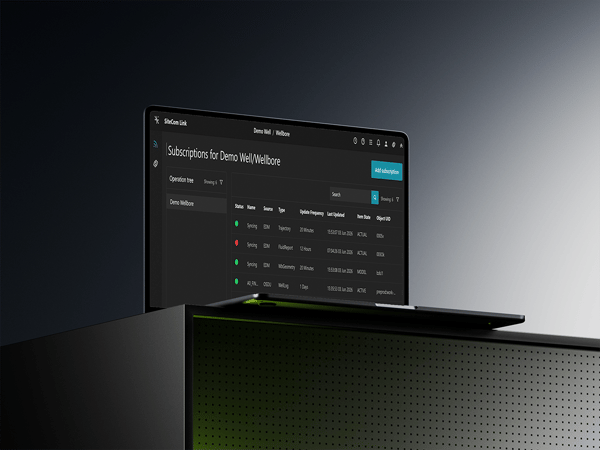
What does SiteCom Link do?
SiteCom Link acts as the integration layer between external operational systems, planning platforms, and SiteCom Store. It provides a set of configurable connectors and integration services that enable systems to communicate without the need for extensive custom development.
At the foundation is source connectivity. The platform is designed to connect to multiple EDM and OSDU sources, reflecting the operational reality where engineering activities run in parallel across specialised systems, each optimised for a specific domain.
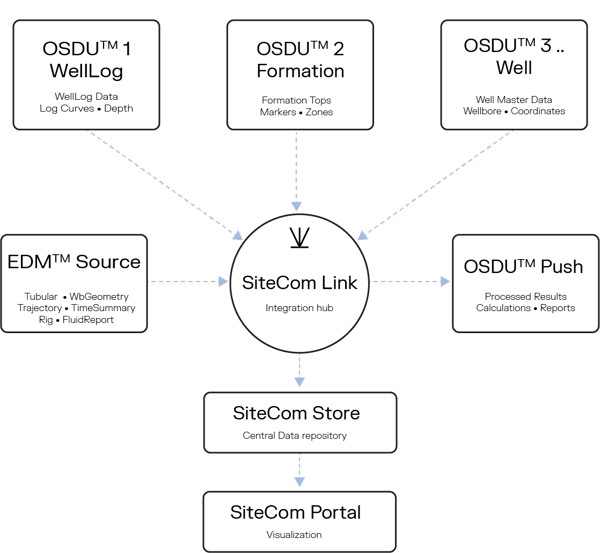
The next layer is mapping and transformation. SiteCom Link enables configurable mapping, transformation, and data fetching to align planning and operational datasets into a consistent operational context. This is essential in environments where object structures and naming conventions differ, and where manual mapping would otherwise be required to reconcile equivalent objects across systems.
A key capability is managed, subscription-based data synchronisation. The platform includes a dedicated backend service responsible for job management, data fetching, and resynchronisation. Once configured, data updates at defined intervals, reducing the need for continuous user intervention and ensuring that changes from source systems are consistently reflected.
Finally, governance is implemented through configuration. Effective integration relies on clearly defined system-of-record ownership, consistent identifiers for wells and wellbores, standardised naming conventions, unit mapping and conversion rules, and structured handling of object states and planning packages. These elements form the foundation required to move from fragile, manual integration towards scalable and automated workflows.
How can SiteCom Link be used?
Consider a simulation-driven operational workflow that combines real-time, planning, and model data into a single execution context. Real-time data is sourced from SiteCom, planning data for upcoming sections is retrieved from EDM, and both subsurface model and revised data are integrated from OSDU data stores. These datasets are used together to enable simulations that reflect both current operations and forward-looking well execution scenarios.
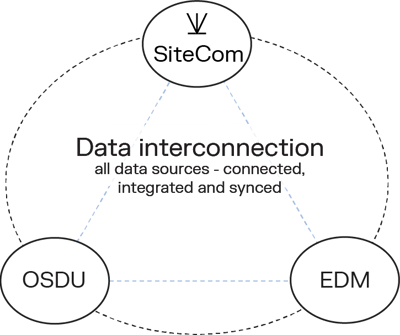
On the planning side, EDM contributes key engineering objects such as tubulars, trajectory, wellbore geometry, and operational reports including drilling and fluids data. From the subsurface domain, OSDU provides model curves, with the potential to extend towards additional contextual elements such as revised formation markers. Simulation outputs are then written back into SiteCom, ensuring that results remain part of the operational data environment throughout well execution.
For example, simulation outputs enable direct comparison between physics-based dynamic models and real-time responses from rig systems and well environments, supporting more informed decisions in drilling, cementing, and pore pressure–fracture control. By stacking simulated scenarios against actual operational data, engineers can detect deviations early, optimise parameters, and reduce the risk of instability or loss events. This effectively creates a hyper-fast digital twin of the well, significantly accelerating hazard identification and enabling proactive operational optimisation.
In practice, SiteCom Link combined with the SiteCom Data Platform (WITSML Store, GM Hub, Data Quality) eliminates manual data assembly. Once mappings are defined, setups are repeatable and automatically synchronised across systems.
Related use cases
September 23, 2026
Correlation in SiteCom Live: placing formation markers with confidence, in real time
June 26, 2026
SiteCom: Avoiding the hidden costs of inconsistent data with the GM Hub
June 19, 2026
SiteCom: Real-time gas shift analysis for understanding pressure behaviour in HPHT wells

June 12, 2026
SiteCom: Why real-time data quality monitoring is now a safety-critical function